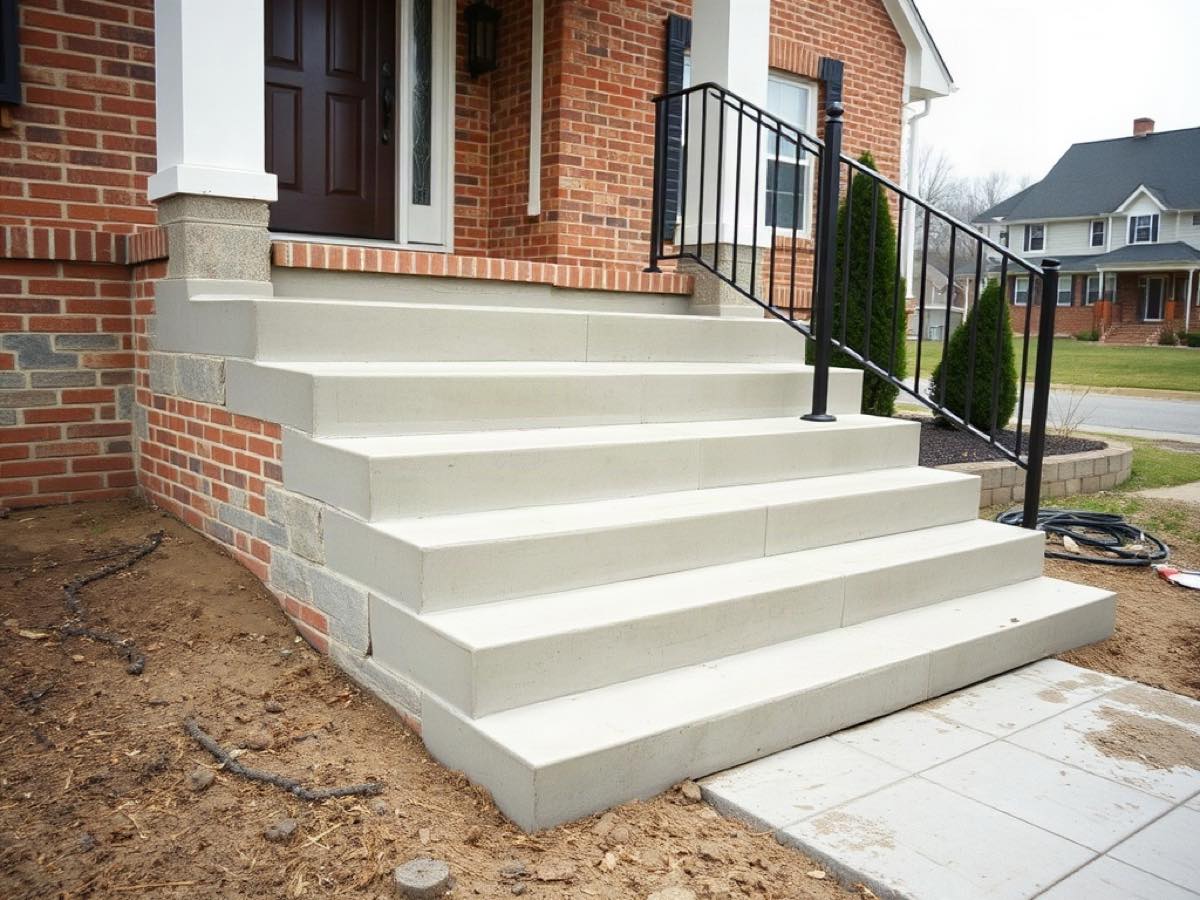
What concrete steps means in Augusta
Riser height and tread depth have to be consistent across a flight, typically within about 3/8 of an inch between the tallest and shortest riser. That consistency is what stops people catching a toe.
Steps are also structural. They carry their own weight plus load, and unlike a slab they cannot simply crack and carry on, which is why footing and reinforcement matter here more than anywhere else on a house.
With shallow frost here, the footing depth on steps is set by bearing on clay rather than by frost line. Clay that has been backfilled and not compacted is the reason steps in Augusta settle.
- Thickness
- footing below the frost line and bearing on undisturbed subgrade
- Mix
- 4,000 psi with #4 bar tied into the footing
- Ready to use
- 7 days before use, 28 before handrail loading
- Typical cost
- $200–$450 per step
- Service life
- 40 years on a proper footing
How concrete steps is poured
The flight sits on a footing below the frost line where there is one, and it is tied or isolated from the house depending on the detail. Steps poured onto backfill without a footing settle and pull away from the house, and that gap is the classic sign.
Reinforcement is bar rather than mesh, tied into a cage, because a step has a cantilevered nose that carries load in tension.
Forms are built and braced properly, because a step form that bows under the weight of wet concrete leaves a riser that is not straight and cannot be fixed afterwards.
Nosings get a light radius or a chamfer. A sharp arris on a concrete step chips within a year and then looks broken.
What concrete steps costs in Augusta, GA
Priced per step or by the flight rather than by area, because the work is forming and reinforcement, not surface. Handrail requirements depend on the number of risers and are worth confirming early.
Steps are quoted per step or by the flight at $200–$450 per step, separately from any slab, because the work is forming and reinforcement rather than area.
Where concrete steps goes wrong in GA
Steps poured against a house on compacted fill, with no footing, are the single most common failure we are called to replace. They settle, tilt back toward the wall, and then hold water against it.
Steps poured on fresh backfill against a house on this clay tilt back toward the wall within a couple of years, and then hold every downpour against the foundation.
Where we do concrete steps
We cover Augusta, Columbia County and the South Carolina side of the CSRA, including and 34 more areas.
Questions we get asked about concrete steps
Do concrete steps need a footing?
Yes, and below the frost line where one applies. Steps on backfill settle and pull away from the house.
How consistent do risers have to be?
Within about 3/8 of an inch across the flight. Beyond that it is both a hazard and a code problem.
Can steps be resurfaced instead of replaced?
If the structure is sound and only the surface has spalled, yes. If they have settled or tilted, no.
Get a free quote
Tell us what you need. We answer the same day, and the on-site visit is free.
Get a price for your concrete steps
Call (762) 320-6343 and we will come out, measure, and leave you a written quote. There is no charge for the visit and no obligation afterwards.