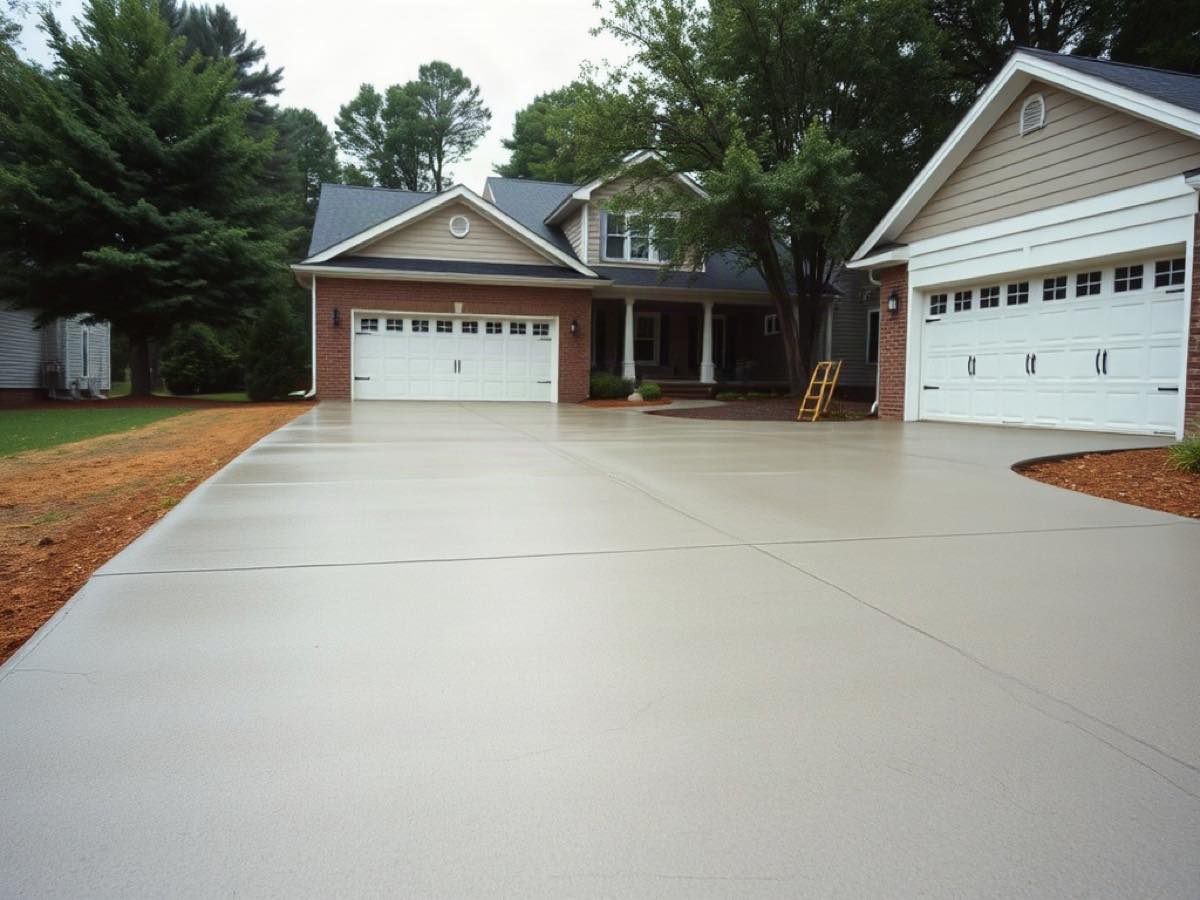
What concrete vs pavers means in Augusta
Pavers are individual units on a compacted base with a bedding layer and jointing sand. Because the joints are everywhere, movement is absorbed between the units and nothing cracks.
Concrete is a monolithic slab. It is cheaper per square foot, gives an uninterrupted surface, and it will crack somewhere, which is why the joints are cut deliberately.
Pavers on plastic clay settle unevenly here, because the bedding layer follows whatever the clay does underneath it. Relaying them is most of the original labour again.
- Thickness
- both options assume a properly compacted stone base
- Mix
- the base matters more than the surface either way
- Ready to use
- n/a
- Typical cost
- varies by option
- Service life
- varies by option
How the numbers on concrete vs pavers are built
Repair behaviour is the real difference. A stained or broken paver is lifted and replaced and the repair is invisible. A repair to a concrete slab is always visible on bare concrete.
Maintenance runs the other way. Pavers need joint sand topped up, they settle unevenly over time and need lifting and relaying in places, and weeds and ants colonise the joints. A concrete slab needs an occasional sealer and nothing else.
Stamped concrete exists precisely to sit between them: the appearance of units at close to the price of a slab, with the crack behaviour and the low maintenance of a slab.
Installation time and disruption favour concrete on a large area and pavers on a small one with curves and level changes, where forming a slab is proportionally more work.
What concrete vs pavers costs in Augusta, GA
Pavers are more expensive to install and more expensive to maintain, and they are the right answer where you want to be able to lift and replace, or where the design has many curves and level changes.
More expensive than the $6–$15 per square foot range to install and more expensive to maintain, and they buy you units that can be lifted and replaced invisibly.
Where concrete vs pavers goes wrong in GA
Pavers laid on a base that was not properly compacted settle into ruts and waves, and relaying them is most of the original labour over again.
Pavers laid on a base that was not properly compacted over Augusta clay develop waves and ruts within a few seasons.
Where we do concrete vs pavers
We cover Augusta, Columbia County and the South Carolina side of the CSRA, including and 34 more areas.
Questions we get asked about concrete vs pavers
Are pavers better than concrete?
They do not crack and individual units can be replaced invisibly. They cost more to install and need joint sand and occasional relaying.
Which is lower maintenance?
Concrete, clearly. An occasional sealer against topping up joint sand, weeding and relaying settled areas.
What if I want the look of pavers at concrete prices?
Stamped concrete exists for exactly that. Unit appearance, slab price, slab maintenance.
Get a free quote
Tell us what you need. We answer the same day, and the on-site visit is free.
Get a price for your concrete vs pavers
Call (762) 320-6343 and we will come out, measure, and leave you a written quote. There is no charge for the visit and no obligation afterwards.